
It’s been a while since I read the book, Rich Dad Poor Dad by Robert Kiyosaki. But this was one of those books that left a lasting impression on me. It challenged me to take risks to set my family and myself up for the future.
There were definitely certain things that I disagreed with that didn’t align with my values, but for the most of it, it was a huge education piece and it was a kickstart to my financial journey.
In this blog I’ll briefly touch on areas that I don’t entirely agree with, share my thoughts on the broken system (contextualising this to Australia), how this has shifted the way that I think, and lastly how I have applied my learnings.
Disagreement
There’s a moment where Kiyosaki quotes both his rich dad and poor dad - “one dad would say, ‘The love of money is the root of all evil’. The other said, ‘The lack of money is the root of all evil.’”. Then he goes on to say later in the book that “Our culture has educated us into believing that the love of money is the root of all evil.”
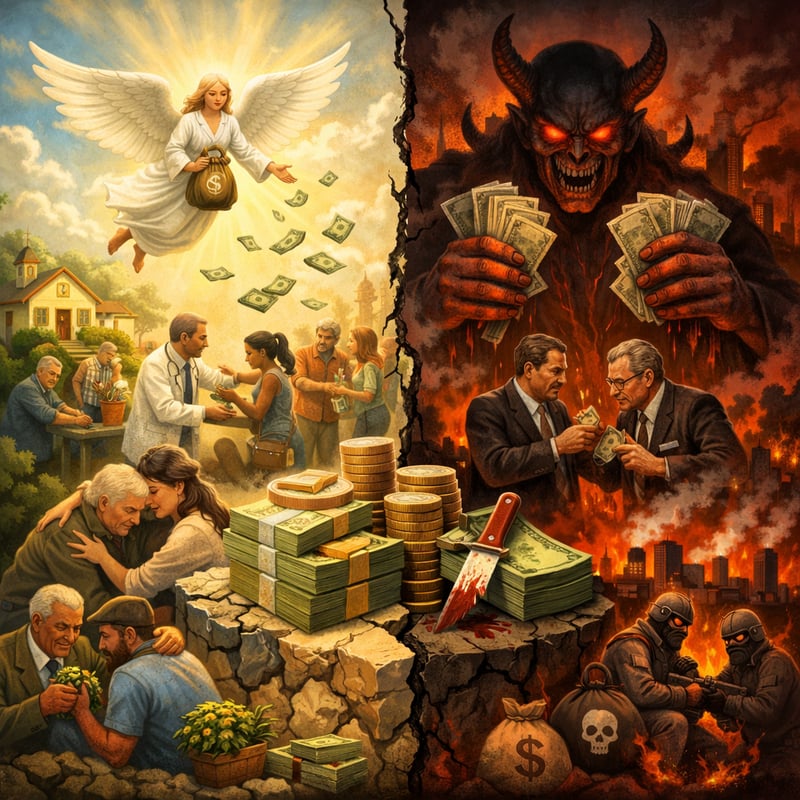
I don’t agree with his statement. It wasn’t our culture who taught this, but the Bible. However, this passage is often misquoted and misunderstood. The verse actually states that “the love of money is a root of all kinds of evil”, emphasising that it is a major source of harm—not the sole cause. The warning is not against money itself, but against the craving for wealth, which can lead to greed, a drifting away from faith, deep sorrow, and the neglect of higher purpose.
Why am I pointing this out? Because it is important for us to know this context before pursuing something like money.
Money is not everything, but is definitely a huge part of our lives. So I do want to point out that even though I don’t believe that everyone should be rich, I do believe that everyone needs to learn the management of money which this book helps with.
Another area that I agree to disagree with is where Kiyosaki points out “poor people are more greedy than rich people”. I kind of understand where he is coming from - because when you're poor, it’s harder to be generous and there is more at stake - in a sense where maybe they won’t be able to pay their bills or feed their family if they were to be generous. They can come off as stingy or greedy for wanting more things in life (or just the basics in life).
But let me give you a different perspective. Rich people have the privilege of being more generous due to the wealth they have stored up. However when you look at the percentage of what is actually being given away, you can say that when a poor person is being generous it’s significantly more than a rich person. Yes, in the world’s eyes the poor person’s gift may be close to nothing and it may make no impact. But when you see it in God’s eyes, it's completely different. And He gives multiple examples of this in the Bible:
- The Widow’s Offering (Mark 12:41–44; Luke 21:1–4)
A poor widow gives two small coins at the temple—far less than the rich—but Jesus praises her because she gave everything she had, while others gave out of their excess. - The Widow of Zarephath (1 Kings 17:8–16)
Facing starvation, a widow gives her last food to Elijah in faith. God honors her sacrifice by continually providing for her throughout the famine. - The Macedonian Churches (2 Corinthians 8:1–5)
Though suffering and extremely poor, the Macedonian believers give generously to help others, and Paul praises them for giving beyond their means with joyful devotion. - Principle of Sacrificial Giving (Proverbs 22:9; Psalm 41:1)
Scripture consistently teaches that God values generosity rooted in compassion and sacrifice rather than the size of the gift.
So yes, even though I understand where Kiyosaki is coming from, it is not completely true. I personally believe money rarely cures greed - it feeds it.
Broken System
Kiyosaki touches on a couple of things about the broken system that I’m super passionate about. First being the broken education system. The problem with our education system is that it doesn’t teach us how to make or manage money. Instead, it conditions people into stagnant lifestyles—unable to think independently or exercise creativity.
It’s like teaching someone to chop wood, and only to chop wood.
 The wood-chopper shows up every day from 9 to 5, swings the axe, earns minimum wage, and goes home. When someone asks what the wood is for, he shrugs and goes home, to a house built out of straw.
Stop and let this sink in. That’s messed up.
We’ve been programmed the same way—not to question, not to look beyond routine. Yet all it takes is curiosity for the wood-chopper to ask where the wood is going, what it’s used for, and what else it could become. That understanding could change his path—or even save his life (or get himself a home built out of wood).
Like the wood-chooper, we are no different. We need to break this routine to not only unlock the potential of earning more money, but to break the cycle of complacency and the routine of chasing our own tail.
Another interesting point that Kiyosaki points out is how our tax money is being used by our government. In government, they need to avoid excess money. If you are not successful in spending all your allocated money, you risk (almost certainly) losing it in the next allotted budget. So you will see the excessive use of tax payer’s money going to places that most citizens won’t even agree with.
As a result, naturally there is more of a demand for budget increase, and the idea of “tax-the-rich” stems from it. Ironically, taxing the rich will never be enough because they know how money works, so this trickles down to the middle class and lower class. So unless we change our attitude and come out of the routine that our broken system has brainwashed us into, we as the middle class and lower class are bearing the consequences of the broken system - Increased tax.
Change of Mindset
Rich Dad Poor Dad is a book that sparked something in my mind - something needed to change how I view myself, how I speak, how I manage my goals, and how I manage money.
“If you don’t learn it, you become a slave to money” is what Kiyosaki would say. Especially in Australia, where we can get taxed almost up to 50% of our earnings if we don’t learn how our system works. We will be chasing our tail and be slaves to money. Always trying to earn more and always trying to keep up with the rising bills and tax.
But on the flip side, I also think that if you are always trying to scheme ways to avoid taxes and store up treasures on earth to be the richest person in the room, you’re also a slave to money.
Money - as important as it is, is also a scary thing. When you’re rich, you’re a slave to money, and if you're poor, you’re a slave to money. There’s no winning.
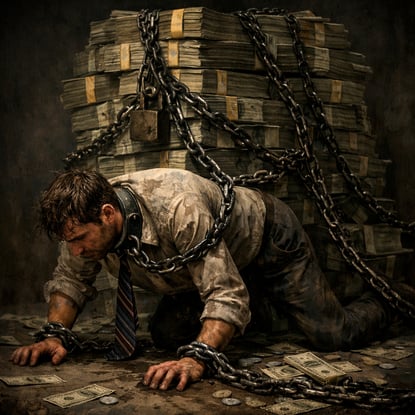
Hence, why we need a higher purpose than trying to escape the matrix. This book made me change my attitude towards money. Money is not something I’m seeking, but it is a resource for me to use to fulfil my purpose here on earth. And that attitude change shifted the way I think about money and how I manage it.
Kiyosaki said something profound in the book: “Intelligence solves problems and produces money. Money without financial intelligence is money soon gone”.
How true is this? So true! Isn’t that the reason why we see half our money missing in our bank accounts?
We need to escape, not the matrix, but complacency. We need to keep learning. But intelligence comes with a twist. You need to be bold. Though Kiyosaki mentions the importance of intelligence, he also touches on the significance of boldness. He states “often in the real world, it’s not the smart who get ahead, but the bold”.
What does that mean? We need to learn to take risks to fulfill our purpose. There is a Texas saying according to the book: “Everyone wants to go to heaven, but no one wants to die.” And Kiyosaki goes on to say: “Most people dream of being rich, but are terrified of losing money. So they never go to heaven.”
Does this not sound all too familiar?: Parable of the Talents.
If you have access to education, a home, food on the table, a community, a job and healthcare, I believe you are the ones with five talents. Do not waste your talents.
Application
So what did the application look like for me?
Firstly, I’ve learnt to manage my cash well - this is going to look different for everyone, but as a framework, my income goes into four different categories: savings, spendings, emergency and investment.
Why is this important? Kiyosaki states that “money is one form of power. But what is more powerful is financial education”. And when you learn to manage your money well, not only are you in the process of starting to build wealth, but you won’t allow money to run your life. YOU GAIN POWER OVER IT.
Something that I’ve also learnt and applied was, not to treat my home as an investment. The problem with the middle and lower class is that we are taught that you are on the road to success as soon as you can buy your own home. We congratulate each other, and envy each other and try to buy a bigger home than our peers to show how successful we are. Kiyosaki calls this “the foundation of today’s debt-ridden society”. If you want to know about the difference between an asset and a liability, I highly encourage you to read this book.
If you consider yourself to be in the lower class, I’ve got some positive news for you (my personal opinion). You have a massive advantage over the middle class if you decide to apply learnings from the book. Why? Because the middle class is addicted to consumerism. Even if they learn financial literacy, it’s going to be very very very difficult for them to change the way they manage their money. Why? Because they’re addicted to buying the best house, the best cars, the best watch, the best bags, making sure they are able to flaunt everything that they have to the people around them. It’s like any type of addiction, like alcohol or drugs. The middle is going to struggle.
Conclusion
I hope this encourages you to read Rich Dad Poor Dad. My hope is that I will be able to challenge the people around me, not to become rich, but to become the best version of themselves. And for that to happen, we all need to come out of our comfort zone to grow, in all areas of life. People who avoid failures also steer clear of success. Success doesn’t have to be defined by wealth. You define what success looks like. Just don’t run away from attempting to achieve success.
Check it out: Rich Dad Poor Dad